


Department of Psychology
Welcome to the Department of Psychology
 Psychology is the study of the mind. At Rutgers, we study psychology from different perspectives, including behavioral and systems neuroscience, clinical, cognitive, and social psychology. The mission of the Psychology Department faculty is to combine excellence in scientific research with excellence in teaching our graduate and undergraduate students.
The department encourages and enables undergraduate student research with faculty, offers a wide range of courses including an honors research major, and provides opportunities for fieldwork and internship experiences. Doctoral candidates study with accomplished faculty who are leaders in their field.
Developmental Psychology Minor Electives
Developmental Psychology electives:
01:830:331 Infant and Child Development
01:830:333 Adolescent Development
01:830:335 Adult Development and Aging
01:830:346 Atypical Development in Childhood and Adolescence
01:830:361 Developmental Psychobiology
01:830:394 Community Psychology and Mental Health
01:830:431 Advanced Topics in Developmental Psychology
01:830:432 Advanced Topics in Developmental Psychology
01:830:484 Language Acquisition
Developmental Psychology Experiential Courses (a maximum of 3 credits accepted towards the minor)
01:830:380/381 Fieldwork: Foster Care
01:830:382/383 Fieldwork: Autism
01:830:388/389 Fieldwork: Child Development
“Sensory Coding Workshop - Monday, November 19th hosted at Rutgers University to bring together sensory neuroscientists”
Rutgers Emotion Health and Behavior (REHAB) Laboratory at Rutgers University

Welcome to The REHAB Laboratory!
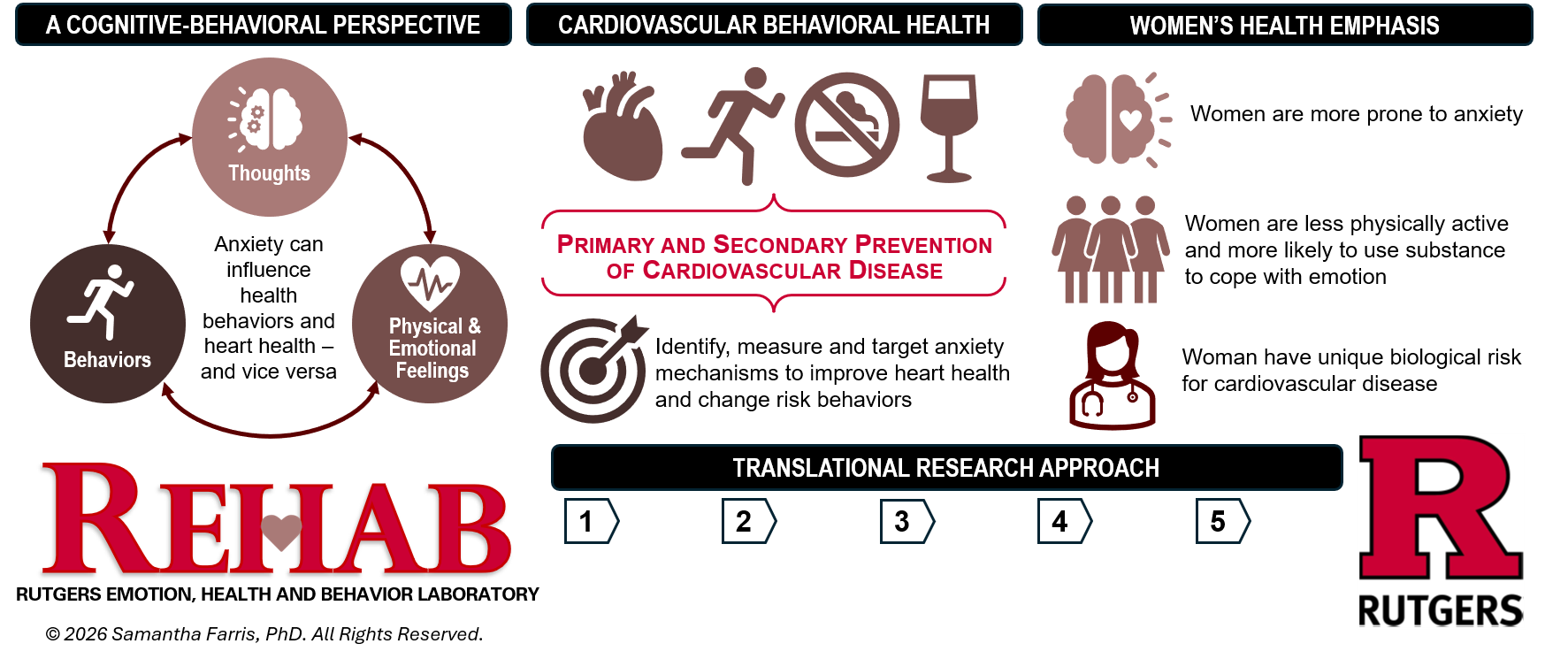
We are a training and research laboratory in the Department of Psychology at Rutgers University, located in New Brunswick, New Jersey. The REHAB Laboratory conducts experimental and treatment research at the intersection of clinical psychology and behavioral medicine. Broadly, our research aims to understand why and how anxiety influences cardiovascular health and risk behaviors (e.g., tobacco use, physical inactivity, alcohol use). Our lab focus on both primary and secondary prevention of cardiovascular disease, with an emphasis on women’s health. Our work is rooted in the NIH’s Science of Behavior Change (SOBC) to behavior change initiative which emphasizes identification and measurement of psychological mechanisms that influence behavior with the goal of developing highly-specified interventions that directly target the hypothesized mechanisms of change. The REHAB Lab utilizes a translational research approach, including 1) naturalistic studies using ecological momentary assessment, 2) measurement development and evaluation, 3) human laboratory experiments, 4) treatment development, and 5) early-stage clinical trials.
The primary mission of The REHAB Laboratory is to improve the physical and psychological well-being of our community. Our secondary mission is to train and educate students to be well-rounded clinical scientists and practitioners in clinical psychology and cardiovascular behavioral medicine.
Explore our website to find out more about our research, team, and current projects!
Dr. Farris WILL be reviewing applications for admissions for 2026-2027 Clinical Psychology PhD program. Applicants with an interest in anxiety, exercise, women's health and cardiovascular disease are best suited for the REHAB Lab.
The REHAB Lab is NOT currently accepting new applications for undergraduate research assistants—please check our website periodically for new openings!
Jonathan Vides
Jonathan Vides
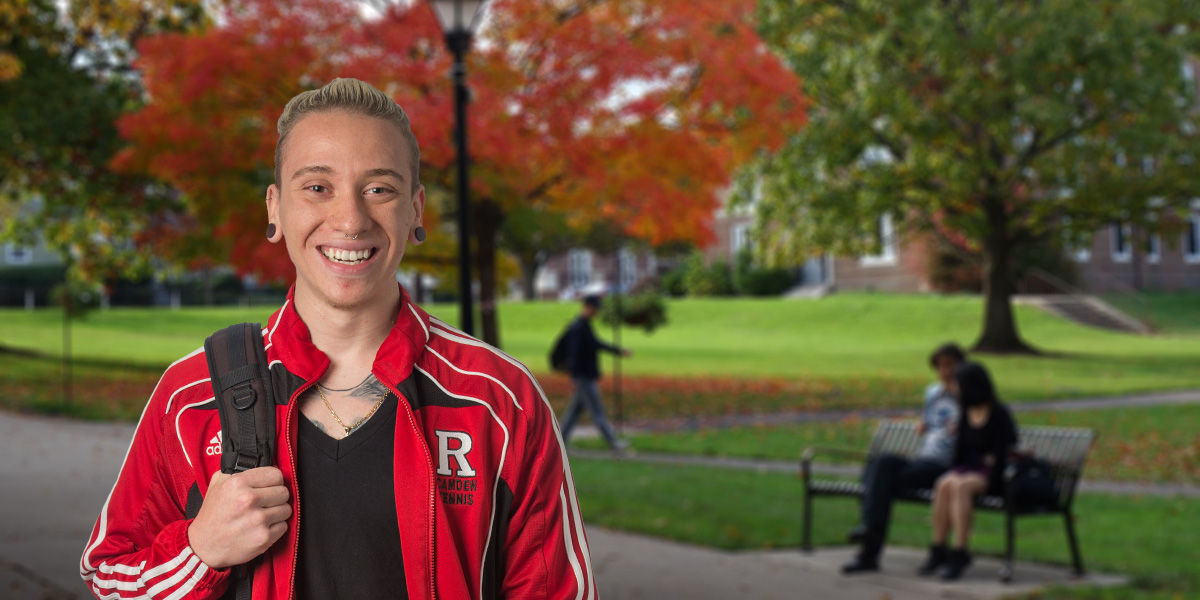
Jonathan Vides has long been fascinated by the human brain, and by issues of race and gender.
So the School of Arts and Sciences senior designed an ideal undergraduate program. He’s majoring in psychology and minoring in both Latino and Caribbean studies and women’s and gender studies. He plans an academic career that will fuse these topics into an integrated field of study.I am trying to understand my own reality through a scientifically grounded perspective.
The son of a Dominican mother and a Salvadoran father, Vides grew up in New Brunswick very aware of his Latino immigrant background and insatiably curious about the lasting impact that the experience might have on him and others.“I want to pursue psychology and find a way to incorporate social concepts such as race,” Vides says. “What’s going on in the brain when we look at race and gender? Why do we see ourselves as so different from one another, and what are the neural processes that push for that?” Vides said his academic interests were shaped by his own life.
“I am trying to understand my own reality through a scientifically grounded perspective,” he says. “How do experiences of stereotyping, social exclusion, or alienation affect us psychologically? What are the things that are holding us back that may not be visible?”
 Vides, working with Diana Sanchez, a professor in the Department of Psychology, is conducting research that directs those questions to other communities. His current project examines how women of color respond to stigmatizing experiences.
“Ultimately, we want to understand how we can help ameliorate the effects of a stereotype in historically threatening environments,” Vides says.
While psychology remains his primary focus, Vides says he’ll leave Rutgers empowered and inspired by the courses he took in his two minors. Latino and Caribbean studies helped him become more fully vested in his own history, while women and gender studies provided what he describes as the intellectual “glue” he needed to develop his theories.
He feels especially grateful to professors Yolanda Martinez-San Miguel and Carlos Decena, who have faculty appointments in both departments, and who inspired him to examine the role of race, ethnicity, and gender in his experience and that of others.
“Honestly, the courses I have taken here have changed me completely,” he said.
Page 1 of 2


